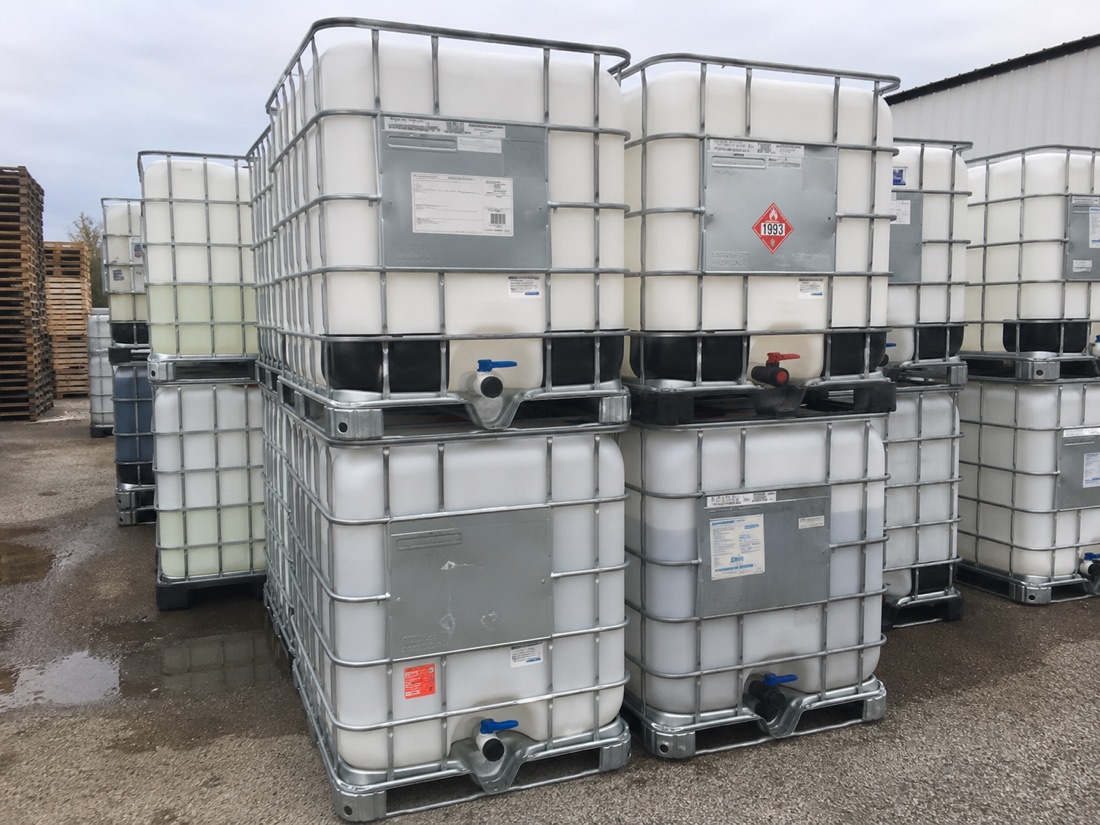
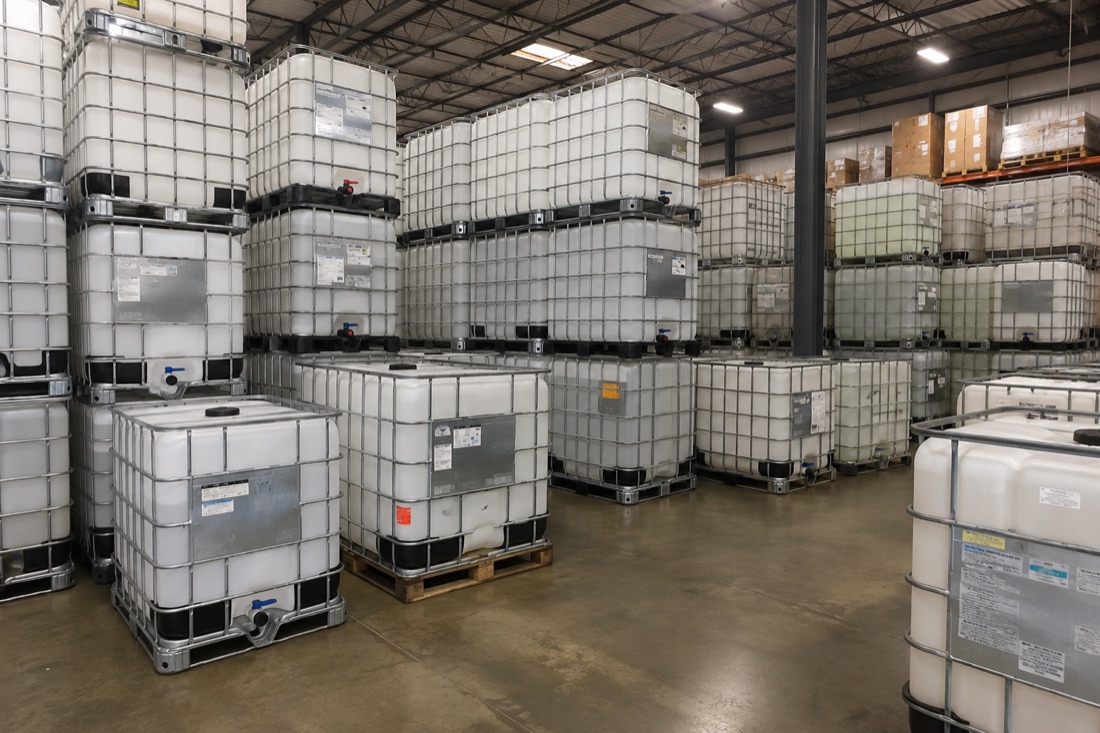
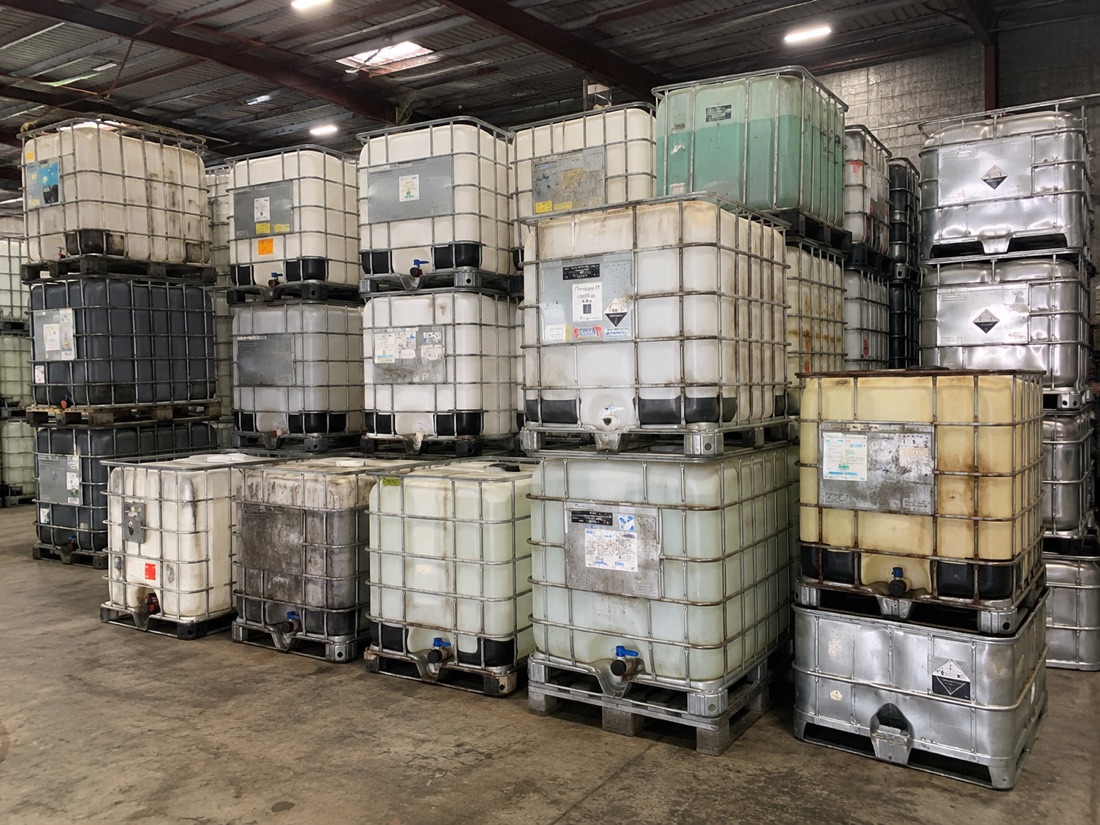
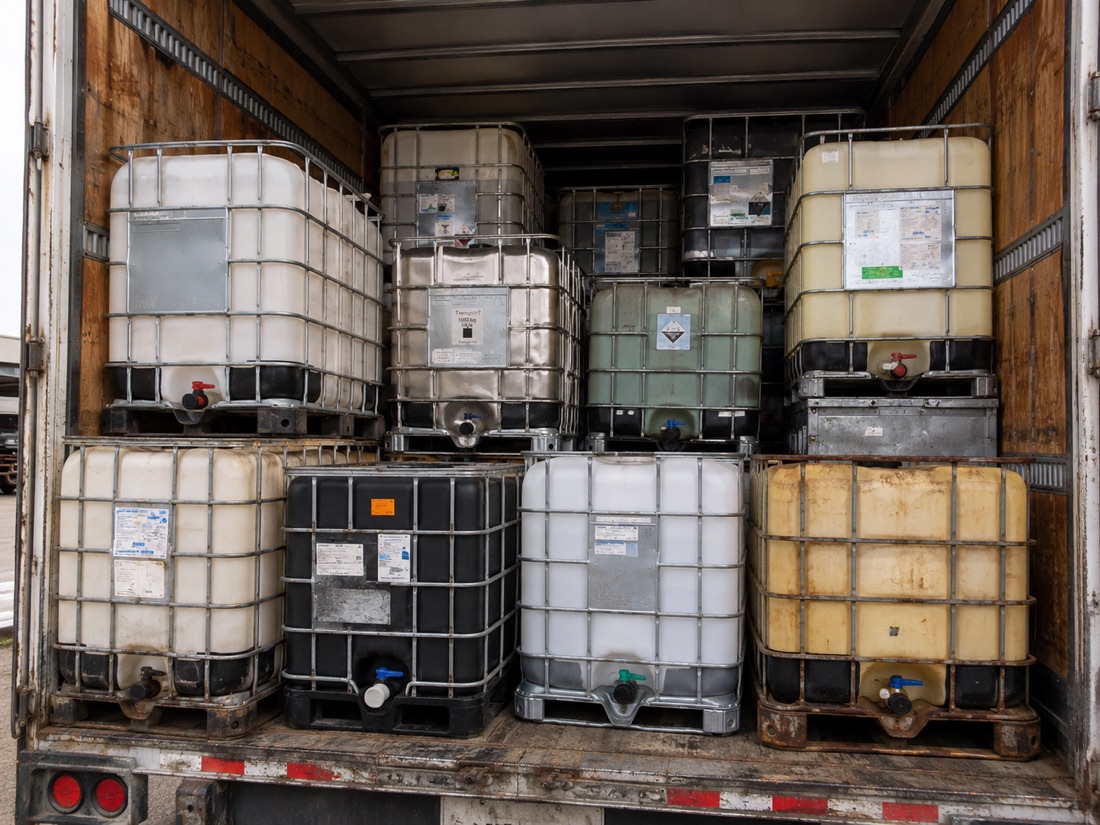
IBC tote reconditioning & recycling.
Reconditioning is the highest form of recycling — it keeps a tote's steel and plastic in service instead of melting them down. Here's exactly how a tired tote becomes a graded, tested, ship-ready unit on our line, and what happens to the rare one that truly can't be saved.
Have totes to recondition or retire?
Send count, prior contents, and condition and we'll tell you what we can bring back to spec.
*Directional estimate; reuse skips virgin resin, cage fabrication, and most manufacturing energy. See our sustainability methodology.
Six stations. One spec.
A tote can only move to the next station after it passes the one before. That's how a used container ends up performing like a new one — and how a failure gets caught long before it reaches a buyer.
Intake & inspection
Every incoming tote is logged, its prior contents verified against paperwork, and its cage, bottle, valve, and pallet inspected. Totes with unsafe histories are routed to hazardous disposal, not the wash line.
Triple wash / hot caustic
Bottles get a multi-stage interior wash — hot water, then a hot-caustic cycle for stubborn residues, then a rinse. Cages and exteriors are cleaned separately. This is what turns "used" into "as-new inside."
Pressure & leak test
Each cleaned bottle is pressure- and leak-tested to confirm it holds. A tote that fails here does not get sold — it gets rebottled or recycled. No exceptions.
Re-bottle
When a cage and pallet are sound but the bottle is damaged or contaminated, we drop in a fresh HDPE bottle. The galvanized steel keeps working; only the part that failed is replaced.
Re-cage & re-pallet
Bent bars are straightened or the cage is swapped; cracked pallets are replaced. The finished unit stacks and forklifts like a new tote.
Re-label & grade
Old markings are removed, fresh labels applied, and each tote is assigned a grade documenting cage, bottle, valve, and prior use — so buyers know exactly what they get.
When a tote genuinely can't be saved.
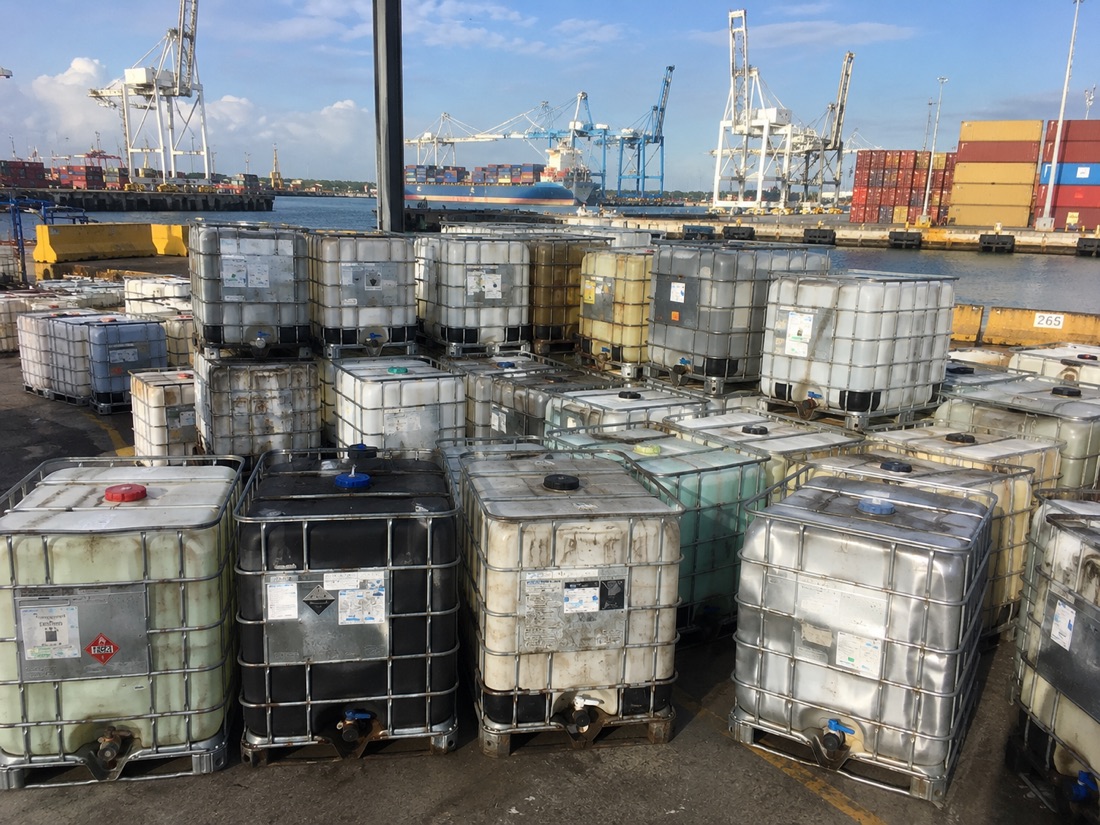
Most totes have years of service left — but nothing lasts forever. When a bottle is cracked beyond rebottling or a cage is too far gone, we don't landfill it. We separate the materials and recycle each stream on its own path.
- HDPE bottle: ground into flake or regrind, feeding new plastic products
- Galvanized steel cage: sent to metal recycling for melt and re-use
- Wood or composite pallet: repaired, reused, or recycled by material
Recycling is the fallback, not the goal. Reuse keeps the whole tote intact and skips the energy of melting and reforming — which is why we exhaust every reconditioning option first.
Reuse > Rebottle > Recycle
1. Reuse the whole tote — wash, test, grade, ship. Lowest footprint.
2. Rebottle the cage — keep the steel, replace only the failed bottle.
3. Recycle by material — separate HDPE and steel, feed them back into supply.
Linear economies dig up, use once, and bury. We close the circle.
The linear model — extract, manufacture, use, discard — treats a composite IBC as disposable, even though it's engineered for thousands of fill cycles. The circular model keeps that engineering in play: collect the empty, restore it, put it back to work, and only recover raw materials when the container has given everything it can. Reconditioning is the engine that makes the circle turn.
Buy reconditioned, sell your empties.
Shop reconditioned totes
Everything off this line, graded and priced by volume, ready to ship.
Browse stock →Sell us your empties
Feed the line — turn idle totes into cash and keep them in circulation.
Get a buy quote →Understand the grades
See how cage, bottle, valve, and history map to the grade on every tote.
Read the guide →The three parts of a composite IBC — and how each is renewed.
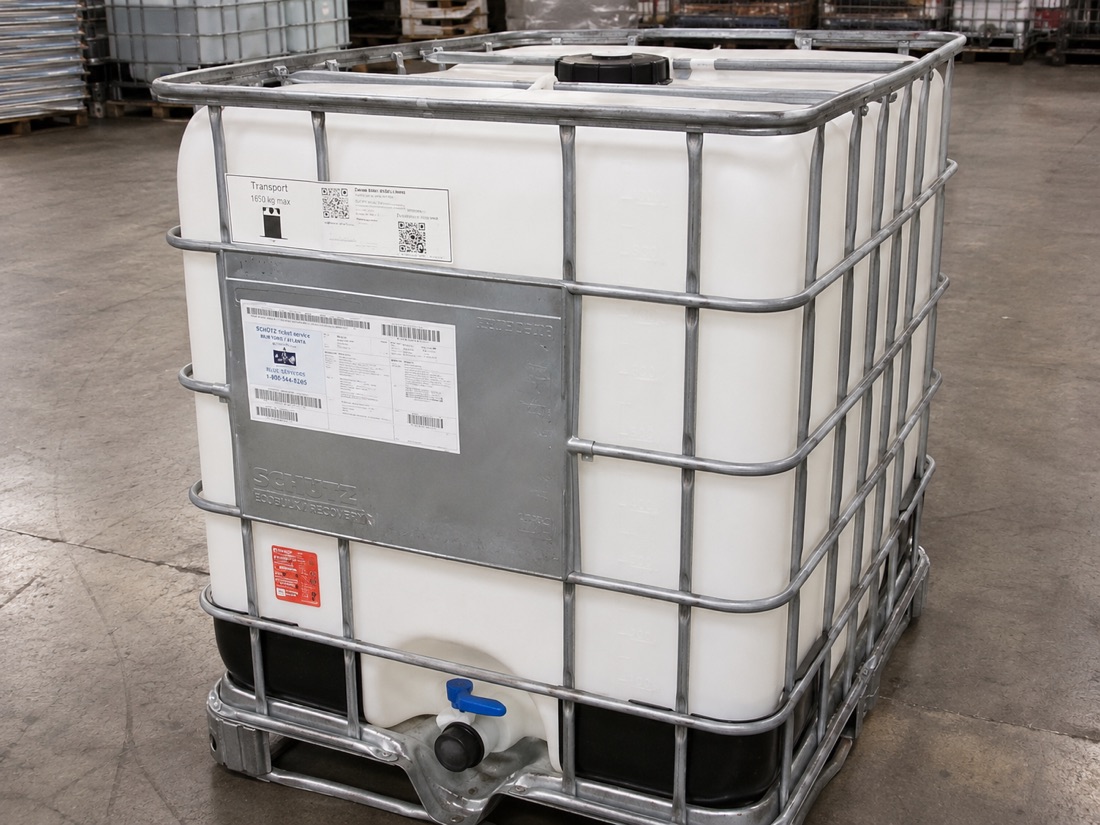
A caged composite tote is really three components living together. Knowing how each ages tells you why reconditioning works so well: rarely does the whole unit fail at once, so we renew the part that needs it and keep the rest in service.
| Component | What it is | How we renew it |
|---|---|---|
| HDPE bottle | Blow-molded plastic vessel, ~275 or 330 gal | Triple-washed & hot-caustic cleaned; rebottled if cracked or contaminated |
| Galvanized cage | Welded tubular steel frame that carries the load | Bent bars straightened or the cage swapped; kept across many bottle lives |
| Pallet base | Integral steel, wood, or composite skid | Repaired or replaced so it forklifts and stacks like new |
| Valve & caps | 2" outlet valve (S60x6) and 6" fill cap | Cleaned, tested, or replaced with fresh hardware |
The steel cage is the long-lived hero — it can outlast several bottles. That durability is exactly why rebottling beats remanufacture. See the full IBC tote guide.
The gates a tote must clear to be sold.
Reconditioning is only as good as the checks behind it. A tote can't advance to the next station until it passes the one before — and a unit that fails any hard gate is pulled for rebottling or recycling, never shipped as-is.
- Contents verified against paperwork at intake — unsafe histories never reach the wash line
- Wash confirmed visually and by residue check before testing
- Pressure & leak test — hard pass/fail; a bottle that won't hold is out
- Structural check on cage, welds, and pallet before re-caging
- Grade assigned and documented so buyers know cage, bottle, valve, and history
Same performance, a fraction of the footprint
A properly reconditioned tote holds product and stacks exactly like a new one — the difference is the ~90% embodied energy you skip by not molding fresh HDPE and fabricating a new cage.
For products that truly require zero history, we stock first-use new totes too — but reconditioned covers most industrial liquids.
Why reconditioning is the greenest thing you can do with a tote.
The most sustainable container is the one already built. Every composite IBC embodies the energy of extracting and refining petroleum into HDPE resin, blow-molding a bottle, mining and galvanizing steel, welding a cage, and assembling a pallet. Landfill that after a single fill and all of it is buried — roughly 100 lbs of HDPE and galvanized steel per tote, plus the energy behind it.
Reuse first, recover last
Recycling — melting plastic and steel back to feedstock — is genuinely valuable, but it still spends energy reforming material and downgrades some polymer with each cycle. Reuse skips that entirely. A washed, tested, regraded tote goes straight back into service with none of the melt-and-mold footprint, which is why we treat recycling as the fallback and reconditioning as the goal.
Reuse the whole tote, rebottle the cage, recycle the material — in that order, every time.
Multiply one tote by a truckload, and a truckload by a year of standing orders, and the arithmetic gets serious fast. Model your own program in the loop calculator, or read the full sustainability methodology behind our numbers.
Common questions about the process.
What's the difference between reconditioning and recycling?
How is the tote actually cleaned?
How much energy does reconditioning save?
What happens to a tote that can't be saved?
How many times can a tote be reused?
Keep the material in the loop.
Whether you're buying reconditioned or retiring old totes, we'll route every one to its highest reuse. One form, one business day.